Tuesday, 25 March 2014

Why we choose Public Sector Job?

A PSU job  is the dream of many an Indian. Jobs here mean a good pay cheque, perks, decent career growth and most important, job security. Recruitment by PSUs has always been in large numbers. 

Hiring process for jobs:
To ensure recruitment of better quality personnel, it has always been the policy of these companies to hold an entrance test followed by a group discussion and finally a personal interview.  Some major PSUs like NTPC, BHEL, POWERGRID, IOCL, and BPCL, used to conduct exams separately for entry-level engineering positions like ‘Technical Trainees’ and ‘Graduate Engineers’ to ‘Management Trainees’. The number of applications for these exams have always been huge – 10,000 applications for as few a 1000 posts, sometimes for even 500 posts or less! Sifting through these to shortlist candidates, conducting the entrance test, group discussions and personal interviews – consumes effort, time and money. To recruit a miniscule number of trainees in terms of the company’s actual employee rolls was becoming a huge and unavoidable problem.
Hiring via GATE:
Now, 14 public sector companies have announced recruitment via GATE 2013, which will be conducted in two phases – one on January 20 followed by Phase 2 on February 10, 2013. Openings for engineering graduates to the tune of 1,874 positions (plus those not mentioned by some companies) have already been advertised for!

This is a huge number compared to a year back when merely two or three companies used GATE as a compulsory criterion to screen candidates. IOCL was the first PSU to kick off the trend. The company got good candidates proficient in their subjects. After the success of their recruitment strategy, NTPC and others followed, and in 2012 eleven more announced recruitment through GATE 2013. BPCL, POWERGRID, NTPC, BHEL, BEL and many more have advertised and more are expected to follow.

Apart from these companies, many other research institutes like BARC, and Junior Research Fellowships in CSIR Laboratories and CSIR-sponsored labs also seek scientists and researchers through GATE.

The GATE edge:
Held by the IITs the credibility of the exam and scores is unquestionable. Those qualifying GATE are not only considered to be good at their subject, the exam pattern ensures that candidates have strong analytical and decision-making abilities. Besides, mastering an entire course of Engineering (30 plus subjects) for a three-hour test, is tough! Having one single test also does away with the expense of holding a separate exam to shortlist suitable candidates. Also, one can expect the employment procedure to be transparent up to a certain point.
Advantages for students:
This trend cuts out preparation time that would otherwise be consumed if there were different exams for each company. It also gives the chance to concentrate on the subjects and practice for a single paper pattern. After qualifying for the exam, the student has the option to either go in for higher studies i.e. post-graduation or opt for a job.

Some constraints:
Not all disciplines have this opportunity as most PSUs have the need for personnel of only certain engineering disciplines (view box). Also, one exam carries too much weight and for non-qualifiers, it would be a major setback with not many options left after it.

Job criteria and perks:
The general age limit is from 25 to 28 years. Pay packages range from 5 lakhs to 12 lakhs per annum, and other benefits. Some companies ask for  a surety bond for 2-3 years to ensure that the employees do not leave at the first opportunity. Payment of application fee is absent for most companies (though it is a part of the application form for some companies, to be paid online or via a DD).

A high stakes test:
GATE 2013 has almost gone fully online, and it is expected that the results would be more reliable. It is also believed that it is a completely transparent process. So, GATE 2013 has a lot at stake for students. It has become the decision maker for them. They qualify to either go on to a higher education or a good career platform. Either way it seems to be the ‘Gateway’ to success!

Monday, 10 March 2014

ANALYSIS OF GATE-2014 QUESTION PAPERS

The following are the changes made in GATE-2014 Examination Based on the student test experience. 
     1. GATE-2014 exam has been conducted in 4 sets of each paper.  
          2.    The questions were different in each session.
     3.     The level of questions were also different from session to session
4.     GATE cut-off marks may vary between 27-30 marks (general category).
5.     Numerical Questions are major role in all papers.
6.     The numerical Question can be solved Based on Formula.
7.     50% of the Questions are problems only.
8.     Due to Numerical Questions, students are confused while answering.
9.     Due to more Numerical Question the time management is major role.
10.  More no. of Questions is based on in depth knowledge of Basics.

The weight-age of the subjects as shown below based on sets.

Electronics and communication engineering:-
We found in one of the set equal weightage for all subjects. Paper was easy, even an average student can get a score of minimum 40 marks. Paper contained only basic questions.

Digital, Electronic & devices circuit, Electro-magnetic field theory part can be scored well.

Aptitude and maths can score full.

            In another set almost 20 questions on EDC and ANALOG, around 12 questions of 2 marks and remaining 1 mark questions. Control systems there was 7 to 8 questions in that 4 questions of 2 marks and remaining 1 mark questions. Network was having fewer ratios of questions like 3 of 2 marks and 1 of 1 mark. Communication systems were having 5 to 6 questions it was 2 mark questions. EMFT was having 5 to 7 questions in that 4 of 1 mark questions and 2 questions was having 2 marks, then MATHS was around 12 to 14 marks.

            In another set we found control systems 1 question, networks 3 questions, from microprocessor no question communication were 12 questions.

            In last set can give approx marks distribution for EMFT about 12 marks,  Analog 11-14 marks, Controls 9-12 marks ,communication 10 marks, Digital and signals and systems 6 marks each , Networks less than 10 marks(9-10)only, and Maths Aptitude 15 marks each.

Electrical engineering:
            In one set we found Analog , power systems and signals and systems more no of weight-age.

And one more set from Machines subject  more no of questions asked  and then power systems around 15 marks ,measurements around 14 marks, power electronics 3 questions ,from Digital less no of questions around 2-3 Microprocessor 2 questions and Maths & Aptitude around 15 marks each.

Mechanical engineering:
            The questions of Gate-2014 mechanical are based on fundamental and concept of the syllabus. 

In one set Aptitude 15 marks, maths 8-10 marks, engineering mechanics no question, strength of material 6 marks, theory of machinery 10 marks , vibrations 4 marks, design 4 marks, fluid mechanics 4 marks, heat transfer 7 marks, thermodynamics 2 marks, production around 6-7 marks inventory and operation research around 10-12 marks.

In another set Aptitude 10 marks, Maths 2-4 marks, Engineering mechanics 3  questions, strength of material 2 questions, theory of machinery 1  question, vibrations 3  questions, design 1  question, fluid mechanics 4  questions, heat transfer 2  questions, thermodynamics 2 questions ,production around 5 questions inventory and operation research around 2-3  questions.

In another set Aptitude 15 marks, Maths 12 marks, Engineering mechanics 2 marks, strength of material 5 marks, theory of machinery 4 marks , vibrations 4 marks, design 4 marks, fluid mechanics 6 marks, heat transfer 5 marks, thermodynamics 8 marks, production around 12 marks inventory and operation research around 8 marks.

Chemical engineering:
            In this paper we noticed more no of questions from Process dynamic and control, heat transfer. Aptitude around 15 marks, Maths was very little hardly 8-10marks and there were no linked and common data questions.

Computer science & information technology :
            In one set Aptitude around 14 marks, maths & discrete maths 13 marks, digital logic 2-3 marks, computer organization 8-10 marks, c & ds algorithms 8-10 marks, theory of computation 8 marks, compiler design 3 marks, operating systems 6 marks, database management systems around 4-5 marks, computer networks 4 marks, software engineering 1 mark and web technology 2 marks.

In another set Aptitude around 15 marks, maths & discrete maths 12 marks, digital logic 2-3 marks, computer organization 4 marks, c & ds algorithms 10 marks, theory of computation 9 marks, compiler design 4 marks, operating systems 6 marks, database management systems around 6 marks, computer networks 8 marks, software engineering 2 mark and web technology 2 marks.

In another set Aptitude around 12 marks, maths & discrete maths 15 marks, digital logic 2-3 marks, computer organization 8 marks, c & ds algorithms 12 marks, theory of computation 6 marks, compiler design 4 marks, operating systems 8 marks, database management systems around 7 marks, computer networks 6 marks, software engineering 0 mark and web technology 1 marks.

Civil Engineering:
This exam is conducted in two sessions i.e. morning session and afternoon session. The question papers of both sessions are different. The difficulty level of questions are nearly same, the morning session paper seems to be little easier than afternoon session.

In this paper we noticed maths around 10 marks, aptitude 14 marks, strength of materials 6 marks, structural analysis 3 marks concrete structure around 6 marks, steel structure 4 marks, geo technical engineering around 8 marks, fluid mechanics 8 marks, hydrology 2 marks, irrigation 4-5 marks, water resource engineering around 6 marks, environmental engineering around 10 marks, transportation engineering 6 marks and surveying 4 marks.

                                                                Srinivasulu Reddy
                                                               (Managing Director) 
                                                      VANI GROUP OF INSTITUTIONS

Monday, 3 March 2014

Advantages of GATE Exam score

The Graduate Aptitude Test in Engineering (GATE) is an all India examination, jointly conducted by the seven IITs and Indian Institute of Science on behalf of the National Coordination Board GATE, Department of Higher Education. With the mushrooming of various engineering colleges in India and the increasing competition, to test the real caliber of engineering students, GATE is the only yardstick. Every year, lakhs of students across India, appears for GATE exam with the dream of entering into the top level universities and colleges for various post graduate programs like M.E., M.Tech, direct Ph.D. etc. But, there are some less-known facts and essential advantages of Graduate Aptitude Test in Engineering exam every engineering aspirant must know in order to make a fruitful career in technical fields.

Clearing GATE exam with high score worth-a-million. The essential advantages include:
•    A good GATE score can help a candidate get admission in top-notch engineering institutes like IITs, NITs, IIITs, IISC, etc.
•    A candidate can get a stipend of Rs. 8000 to Rs. 14000 per month for M.Tech. Course, which may vary for different institute.
•    A student with M.Tech. Or M.E. gets better remuneration as compared to those with B.Tech. Or B.E. degree.
•    Those who get admission in top institutes like IITs and IISc, can look at a salary package ranging from 7 lakhs to 30 lakhs per annum, depending on the specialization and performance.
•    Many public sector undertakings like BHEL, NHPC, NTPC, etc. prefer GATE scores for selecting candidates.
•    Candidates who have qualified GATE are also eligible for the award of junior research fellowship in CSIR laboratories.
•    Those with good scores have better foreign prospects as compared to graduate level degrees.

A better score definitely gives an edge when it is concerned with joining various reputed companies as well as various off-campus recruitments. Those who couldn’t make it in IIT during their admission for graduation, this exam can provide them with better opportunities to enter the prestigious institutes in India for post-graduation. Preparation for this exam will also help the aspirants to focus on various other prominent PSU exams and certainly give a huge technical edge over others in interviews and career planning. Cracking this exam needs one to practice a lot to deliver the best. Going through previous papers with detailed solutions, analyze the paper pattern and focusing on maximum weightage subjects will help aspirants in better preparation. Preferring to GATE books with fundamental concepts and focus on concept clarity Publication will be an added advantage.

Thursday, 23 January 2014

How to score high in GATE Exam?

The Graduate Aptitude Test in Engineering (GATE) is an All-India examination conducted by the Indian Institute of Technology and Indian Institute of Science, Bangalore, on behalf of the National Coordinating Board – GATE, Department of Education, Ministry of Human Resources Development ( MHRD ), Government of India.
The objective of GATE is to identify meritorious and motivated candidates for admission to Postgraduate Programs in engineering at the National Level. To serve as benchmark for normalization of the Undergraduate Engineering Education in the country.
An average candidate can score high in GATE with 3-4 months of preparation. But, in this duration, you must be completely dedicated for the exam and nothing else should matter as much. You must have proper study plan for it. There is no shortcut for scoring high and all it takes your dedication and efforts. If you study well in these 3-4 months, you can definitely score high. Planning is the very first and most important step. Make a plan so that you can cover each and every topic of the syllabus. Assign each subject a specific time, and give hard subject extra time. Also assign time for revision and practice.
  1. Collect the Syllabus for the GATE exam.
  2. Collect all the relevant books for the subject. This collection must include the books for Fundamental and basic concepts as well as for specific problems, guide book for GATE and previous year question papers
  3. Solve objective type (especially numerical) questions as much as possible.
  4. Mean time you should be in touch with some GATE experienced persons for proper guidance.
  5. Read syllabus and question papers carefully so that it will easy for you to make a proper approach.
  6. Start preparing from the initial topics i.e. the basic ones and note down the basic concepts (definitions, unit, dimension etc.) as well as necessary theories, formulae etc.
  7. Practice more and more problems and follow the same procedure for the rest of the chapters and subjects.
  8. Finally, go for self tests based on whole syllabus and if necessary take help of others in conducting self-tests.
  9. No need to cover the entire syllabus.
  10. Keep preparing your personal notes as you cover topics.
  11. Do not practice questions in rough. You may need to see the solutions at the time of revision.
  12. Go through previous year papers (say last 10 years) to check your knowledge and note the distribution of different topics.
  13. Revision is one of the most important steps of the preparation process (around 20 days before examination).
  14. Follow your notes during this time and solve time-bound question papers (preferably last year papers).
  15. Take a chill-pill on the day before exam. Relax!!!!!!!!!!
  16. Do not make any guesses in the paper. If possible, try to eliminate the choices by minimum calculation/analysis.
  17. Even you find the paper tough, DO NOT panic.

Friday, 3 January 2014

Public Sector Recruitments through GATE Exam Score


Public Sector Undertakings (PSUs) in India facing troubles for long time in recruiting candidates with more than 100,000 students competing for less than 1000 thousand jobs ( selection rate of less than 1%). After the gradual increase in the number of engineering graduates in India who are willing to get a PSU job, the PSUs have decided as GATE exam score is the primary criteria for the initial shortlisting. This change in the recruitment process brought rapid increase in the applicants from GATE 2012.

The first PSU which successfully tested the process of recruitment was Indian Oil Corporation. After two years National Thermal Power Corporation, Bharat Heavy Electricals, Bharat Electronics & Power Grid Corporation of India.

Generally these companies release their job notification right after GATE notification, indicating that Candidate must undergo GATE entrance exam as a primary criteria to get a job in these PSU Organizations.

Latest list of companies (GATE 2014):

The following Public Sector Undertakings have signed Memorandums of Understanding (MoUs) with GATE 2014 organizing committee, for using GATE 2014 score as a screening tool for recruiting engineers at entry level positions in their organizations.

•             Bharat Petroleum Corporation Ltd.
•             Hindustan Petroleum Corporation Ltd.
•             Indian Oil Corporation Ltd.
•             National Fertilizers Ltd.
•             Neyveli Lignite Corporation Ltd.
•             National Hydroelectric Power Corporation Ltd.
•             National Thermal Power Corporation Ltd.
•             Power Grid Corporation of India Ltd.
•             Vizag Steel Plant
•             Gas Authority of India Limited (GAIL)
•             Mineral Exploration Corporation Ltd.
•             Mazagon Dock Ltd.
•             National Aluminium Company Ltd.
•             Rail India Technical and Economic Services (RITES) Ltd.

Many other PSUs are also processing the MoU and these are in progress.

GATE Examinations for all the 22 papers will be conducted by an online Computer-Based Test (CBT). The online examination paper will contain some questions for which numerical answers must be keyed in by the candidate using the "virtual" (i.e. on-screen) keypad. Rest of the questions shall be of Multiple Choice Question (MCQ) type.

GATE Papers and corresponding codes


For the GATE 2014 examination, a candidate can apply for only one of the 22 papers listed in Table given below. The syllabus for each of the papers is different. Making a choice of the appropriate paper during GATE application is the responsibility of the candidate. Some guidelines in this respect are suggested below.

The candidate is expected to appear in a paper appropriate to the discipline of his/her qualifying degree. However, the candidate is, free to choose any paper according to his/her admission plan, keeping in mind the eligibility criteria of the institutions in which he/she wishes to seek admission. For more details regarding the admission criteria in any particular institute, the candidate is advised to refer to the websites of that institute.

Table: List of GATE papers and corresponding codes

Vaniinstitute

http://vaniinstitute.com/GATE-coaching-GATE-2014-batches-kolkata.html

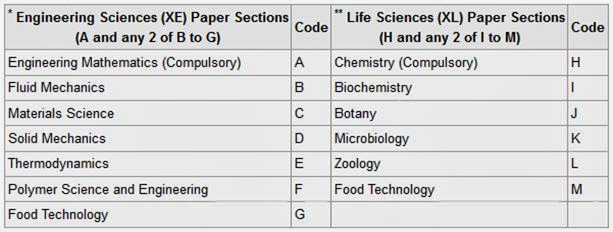
*XE (Engineering Sciences) and **XL (Life Sciences) papers are of general nature and will comprise of Sections listed in the above table. More detailed explanation is given below. 

General Aptitude Questions

All the papers will contain few questions that test the General Aptitude (Language and Analytical Skills), apart from the core subject of the paper.

XE Paper

A candidate appearing in the XE paper has to answer the following

1.     Section A – Engineering Mathematics (compulsory)
2.     GA – General Aptitude (compulsory)
3.     Any two of XE sections B to G

The choice of two sections from B to G can be made during the examination after viewing the questions. Only two optional sections can be answered at a time. A candidate wishing to change midway of the examination to another optional section must first choose to deselect one of the previously chosen optional sections (B to G).

XL Paper

A candidate appearing in the XL paper has to answer the following

1.     Section H – Chemistry (compulsory)
2.     GA – General Aptitude (compulsory)
3.     Any two of XL sections I to M

The choice of two sections from I to M can be made during the examination after viewing the questions. Only two optional sections can be answered by the candidate. A candidate wishing to change midway of the examination to another optional section must first choose to deselect one of the previously chosen optional sections (I to M).

Duration and Examination Type  

The GATE examination consists of a single paper of 3-hour duration that contains 65 questions carrying a maximum of 100 marks. The question paper will consist of both multiple choice questions (MCQ) and numerical answer type questions.

The examination for all the papers will be carried out in an ONLINE Computer Based Test (CBT) mode where the candidates will be shown the questions in a random sequence on a computer screen. The candidates are required to either select the answer (for MCQ type) or enter the answer for numerical answer type question using a mouse on a virtual keyboard (keyboard of the computer will be disabled). Candidates will be provided with blank paper sheets for rough work and these have to be returned back after the examination. At the end of the 3-hour window, the computer will automatically close the screen from further actions.

GATE Admit Card and Registration Number Format


GATE 2014 will be held from February 2 to March 2. Here are 5 things to know about to know about the entrance exam.

GATE 2014 Examination will be held in 2 sessions. The first session will be held from 9 am to 12pm while the afternoon session will be held from 2pm to 5pm. 

The session allotment will be done on a random basis by GATE 2014 administration.

The Admit Card can only be downloaded from the zonal GATE websites from 18th December 2013. Admit Cards will NOT be sent by post/email. Bring a print-out of the downloaded Admit Card to the Test Center along with the original and valid photo identification (NO photocopy / scanned copy/NOT expired). Candidates will NOT be permitted to take the test, if this original and valid photo identification is not presented. It may be noted that you would have specified one of the following IDs during the online application process: Driving License, Passport, PAN Card, Voter ID, Aadhaar UID, College ID, Employee Identification Card, or a Notarized Affidavit with Photo, Signature, Date of Birth and Residential Address.

Precautions during downloading Admit Card:

Candidates facing problem while downloading Admit Card are advised to do the following:

1. Empty cache memory of the browser

2. Close the browser

3. Re-open the browser and login at GOAPS to download your admit card.

Registration Number Format:

Registration number format for GATE 2014 is two alphabet paper code followed by nine digits e.g., AG600101001.
Out of the nine digits, fifth and sixth digits put together indicate the Session Number in which a candidate's examination is scheduled. For example, if the Registration Number is ME601005112, then the fifth and sixth digits put together, i.e., 05 indicates that the candidate's examination is scheduled in Session 05. From the Session number and with the help of the table given below, a candidate can find the date and time at which her/his examination is scheduled.


Thus from the table given below, examination scheduled in Session 05 takes place in the forenoon of 16th February 2014.